 Skip to content

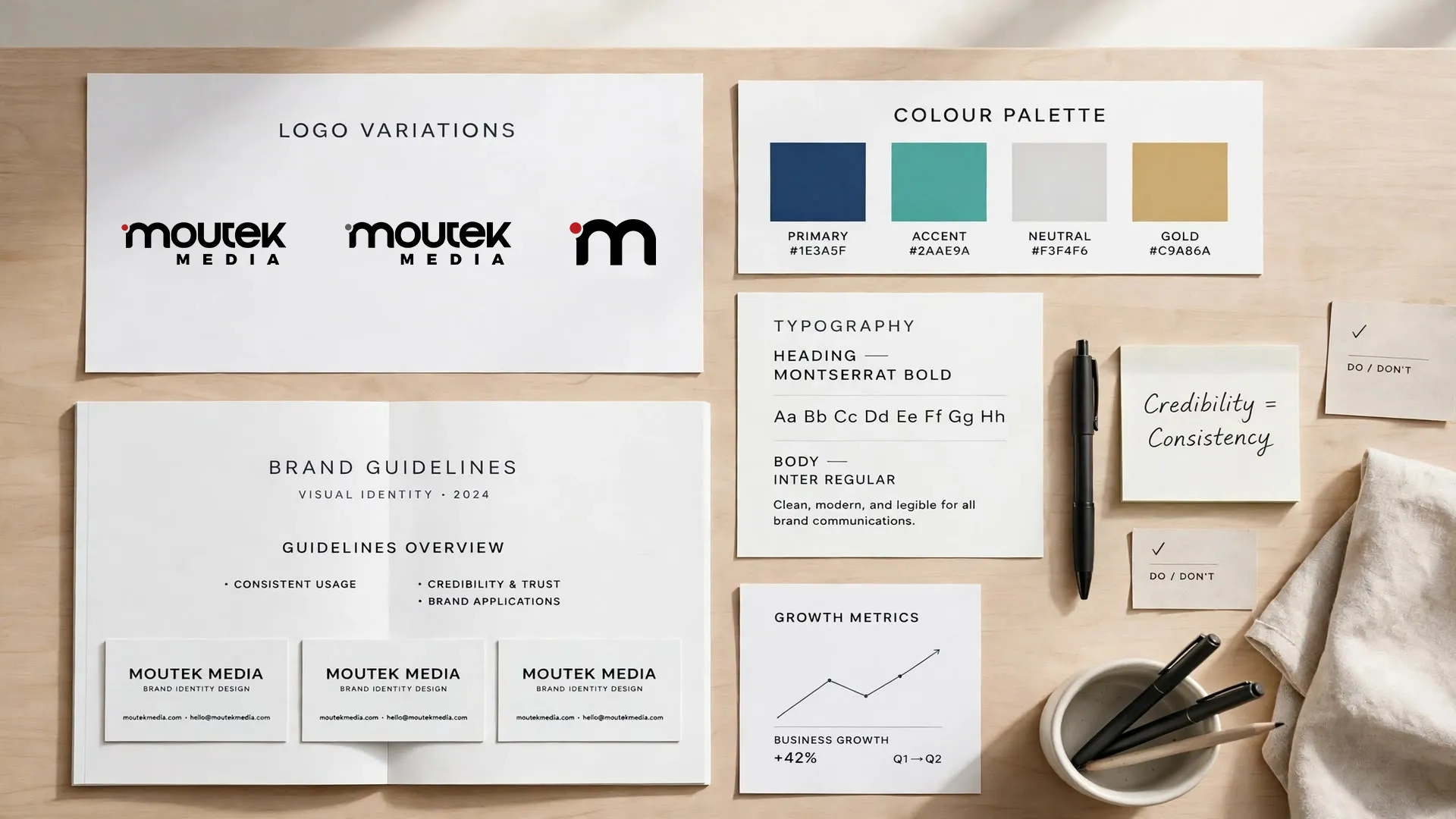
When people encounter your business for the first time, they begin forming an impression before they fully understand what you offer. They may see your logo on social media, visit your website, read a brochure, or notice an advertisement. Each interaction gives them clues about your business, its professionalism, and whether it deserves their attention.
This is where brand identity design becomes important. It gives your business a recognizable and consistent visual presence, helping people understand who you are and what they can expect from you. Although many businesses associate branding primarily with logo design, a strong identity involves much more than a single graphic.
Understanding what brand identity design includes, and how it supports your wider business goals, can help you make better decisions about how your company presents itself.
What Is Brand Identity Design?
Brand identity design is the process of developing the visual elements that represent a business and make it recognizable. These elements work together to communicate the character, positioning, and values of the company across different platforms and customer interactions.
A complete visual identity usually includes a logo, colour palette, typography, graphic elements, image style, and guidelines explaining how these components should be used. Depending on the business, it may also include packaging, stationery, presentation templates, social media layouts, and other branded materials.
The important point is that these elements should not be developed independently. They need to work together as a coherent system.
For example, imagine a professional services company that wants to attract established corporate clients. Its identity might use confident typography, a restrained colour palette, clear layouts, and carefully selected photography. A children’s entertainment business would probably require a very different visual approach. Both identities can be professionally designed, but they need to communicate different things because they serve different audiences.
Effective brand identity design begins with understanding the business, rather than choosing colours or styles simply because they look attractive.
How Is Brand Identity Different From a Logo?
A logo is an essential part of a brand identity, but it is not the entire identity.
The logo acts as a recognizable identifier. It helps customers distinguish your business from others, particularly when they encounter it repeatedly. However, a logo alone cannot communicate every aspect of your company’s personality, positioning, or offering.
Consider what happens when your logo appears on a website, a social media profile, a printed proposal, a business card, and an advertising campaign. If each application uses different colours, unrelated typography, and inconsistent visual styles, the business may appear less established than it actually is.
A complete identity solves this problem by creating a visual framework that can be applied consistently. It provides direction for how the business should look, whether a designer is creating a new advertisement or an employee is preparing a presentation.
This is one reason professional logo design should be considered within the wider branding process. A visually appealing logo is valuable, but its usefulness increases when it belongs to a well-considered identity system.
Why Does Brand Identity Design Matter for Business Growth?
A strong visual identity supports several important business objectives.
First, it improves recognition. When customers repeatedly encounter consistent visual elements, they have more opportunities to associate those elements with your business. Recognition becomes particularly valuable when customers are comparing several providers offering similar products or services.
Second, a clear identity can support credibility. People often use the quality and consistency of a business’s presentation as one of several signals when deciding whether to trust it. Inconsistent design does not automatically mean a company is unreliable, but a disorganized presentation can create unnecessary doubts.
Third, brand identity design helps businesses communicate their position in the market. A company that wants to be perceived as accessible, innovative, traditional, premium, or technically sophisticated needs a visual approach that supports that intention. The design should reinforce a credible position rather than simply follow popular trends.
Finally, a consistent identity makes marketing more coherent. Instead of treating every campaign, social media post, or promotional graphic as a separate creative exercise, the business can build on an established visual system. This creates continuity and makes it easier for customers to recognize communications from the same company.
What Makes a Brand Identity Effective?
An effective identity is not necessarily the most elaborate or fashionable one. Its quality depends on how well it serves the business and the people it wants to reach.
It reflects a clear business position. Before developing the visuals, a company should understand its audience, competitive environment, strengths, and intended market position. Design decisions become more purposeful when they are based on this understanding.
It is distinctive without becoming confusing. A business needs to be recognizable, but originality should not come at the expense of clarity. The identity should help customers understand the company rather than leave them wondering what it does.
It works across different applications. A logo and visual system should remain effective on a website, mobile screen, presentation, printed document, or other relevant format. Designers need to consider scale, legibility, contrast, and practical production requirements.
It remains consistent without becoming restrictive. Brand guidelines should establish recognizable rules while allowing enough flexibility for different communication needs. A social media campaign and a corporate proposal do not need identical layouts, but they should still feel as though they come from the same business.
It can grow with the company. As a business introduces new services, enters new markets, or reaches different customer groups, its identity should provide a foundation that can accommodate reasonable expansion.
When Should You Invest in Professional Brand Identity Design?
A new business may need an identity before launching so that its initial marketing, website, and customer communications share a clear direction. An established company may need one when its existing visuals have become inconsistent or no longer represent the quality of its work.
Other reasons include entering a new market, introducing a different service, repositioning the business, or discovering that the current brand looks too similar to its competitors.
In some cases, a logo refresh may be sufficient. In others, the underlying problem is strategic, and changing the logo without addressing that problem will achieve very little. The right solution depends on what is no longer working and what the business needs to accomplish.
Working with an experienced design agency can help clarify these questions before significant time and money are invested in creative execution.
Building an Identity That Works Beyond Appearance
Brand identity design is not simply about making a business look attractive. It is about creating a recognizable visual system that supports the company’s positioning and helps it communicate consistently.
When the strategy, logo, typography, colours, website, and marketing materials reinforce the same message, the business presents a clearer picture of itself to potential customers. That clarity can make it easier for people to understand what the company offers and why it may be the right choice.
At Moutek Media, we approach branding as a combination of strategic thinking and creative execution. We help businesses develop visual identities that reflect who they are, distinguish them in their markets, and provide a consistent foundation for future growth.
If your business needs a new identity or has outgrown its existing one, explore our brand strategy services and logo design services to learn how a more considered approach can help.
